Engineering Foundations of Touchless Technologies in Modern Restrooms
Touchless restroom technology should be specified as a coordinated building system rather than a collection of electronic fixtures. Sensor faucets, automatic soap dispensers, touch-free flush controls and sensor-operated drying equipment all depend on detection geometry, hydraulic conditions, power, basin coordination, water quality, accessibility, cleaning practices, service access and commissioning.
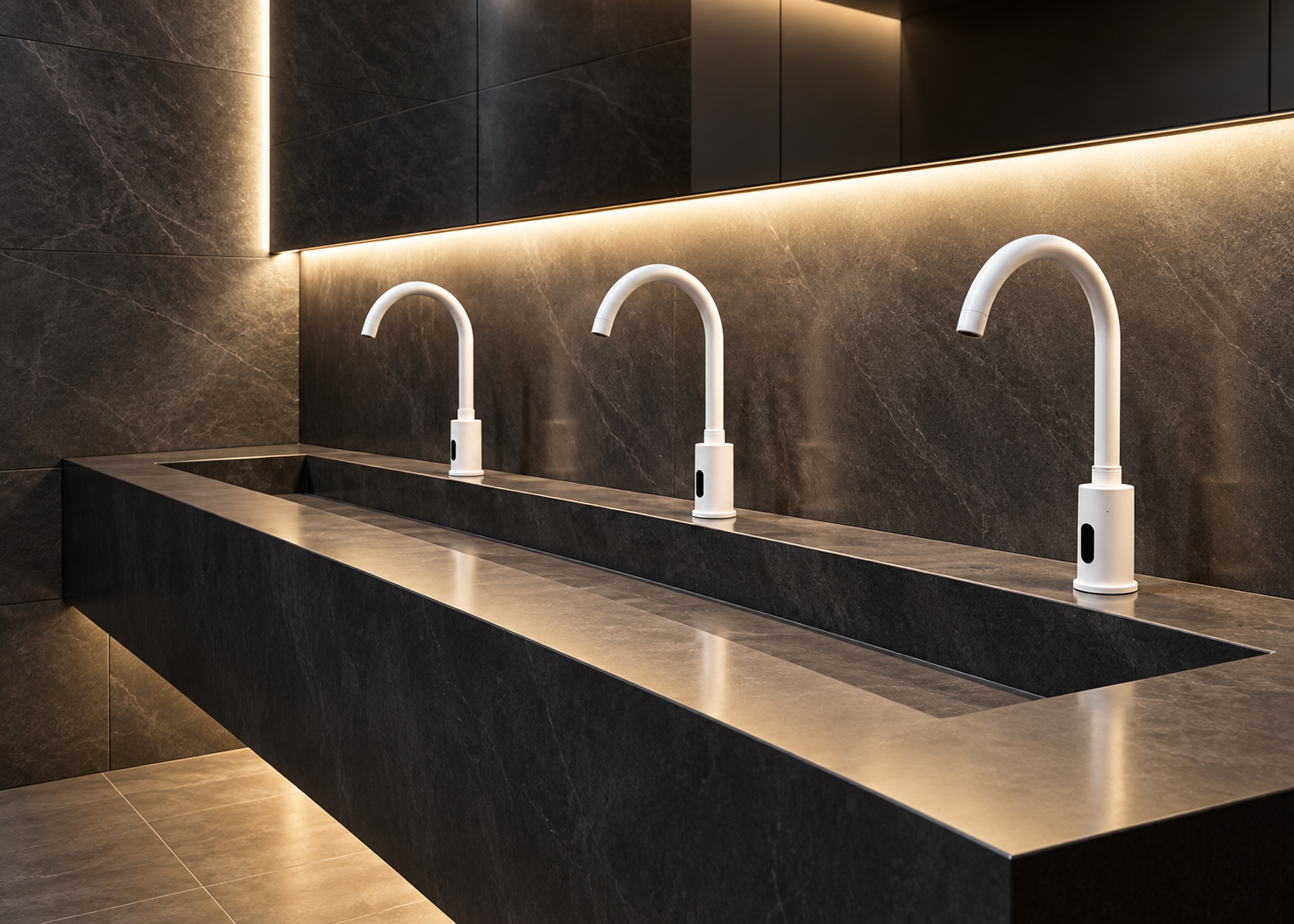
Commercial touchless fixtures perform as part of a complete wash-station assembly that includes the basin, drainage, power, controls, soap system and surrounding surfaces.
Touchless Restroom Technology From Convenience to Core Building Strategy
Touchless technologies in restrooms have become an important component of contemporary building design, particularly in facilities where hygiene, efficiency and maintenance management are significant operational concerns.
Architects and plumbing engineers evaluating touchless restroom systems typically review conditions that influence real-world performance: sensor false activation caused by movement near crowded sink areas, cross-activation between adjacent fixtures, aerator restriction from mineral-heavy water, nozzle buildup from soap residue, inconsistent soap dispensing volume, pressure variation in larger plumbing networks and maintenance accessibility where electronic controls interface with conventional mechanical plumbing.
Airports, hospitals, universities, hotels, office complexes and transportation facilities can place different demands on the same technology. A faucet that performs effectively at one private lavatory may require different sensing, power, vandal-resistance and maintenance considerations when repeated across a bank of public sinks.
Performance
Detection range, response, shutoff, flow, dosing and duty-cycle behavior.
User Experience
Intuitive activation, hand position, accessible reach and predictable wash sequence.
Integration
Plumbing, power, countertop geometry, rough-ins and service access.
Operations
Consumables, cleaning, spare parts, settings, commissioning and maintenance.
Performance and Reliability: What Engineers Should Evaluate
Touchless fixture performance begins with the relationship between the sensing field and the physical environment around the fixture. The controller has to distinguish an intended hand from the basin, drain, backsplash, neighboring fixture, reflected light, standing water and other nearby objects.
This is why sensor performance cannot be evaluated only from the faucet body. The same fixture can behave differently when paired with a deep white basin, a shallow washplane, a polished drain or a reflective backsplash.
Detection Zone and False Activation
A detection field that extends too far can respond to surrounding movement or nearby surfaces. A field that is too short can force users to search for the activation point. Either condition can affect water use and user confidence.
✓ Confirm intended activation distance.
✓ Evaluate final basin and drain material.
✓ Check adjacent fixture spacing.
✓ Test under completed restroom lighting.
✓ Inspect reflective backsplash conditions.
✓ Commission the installed sensor.
Sensor location and orientation influence the usable activation zone and should be considered together with faucet projection and basin geometry.
Infrared, Time-of-Flight and Sensor Selection
Traditional reflective infrared sensors and Time-of-Flight sensing can both support automatic faucet operation, but they provide different information to the fixture controller.
A conventional reflective infrared design typically evaluates returned optical energy and decides whether an object is present inside its sensing region. Time-of-Flight systems are designed to obtain distance information from emitted and returned optical signals, allowing the controller to evaluate whether a target is within a defined range.
Neither approach removes the need for correct installation. A dirty sensor window, weak power source, sticking solenoid, inappropriate range or poor fixture orientation can still create unreliable operation.
Specification takeaway:
evaluate sensing technology together with the complete fixture, basin geometry, power source, valve assembly and commissioning procedure rather than treating the sensor acronym as a stand-alone performance guarantee.
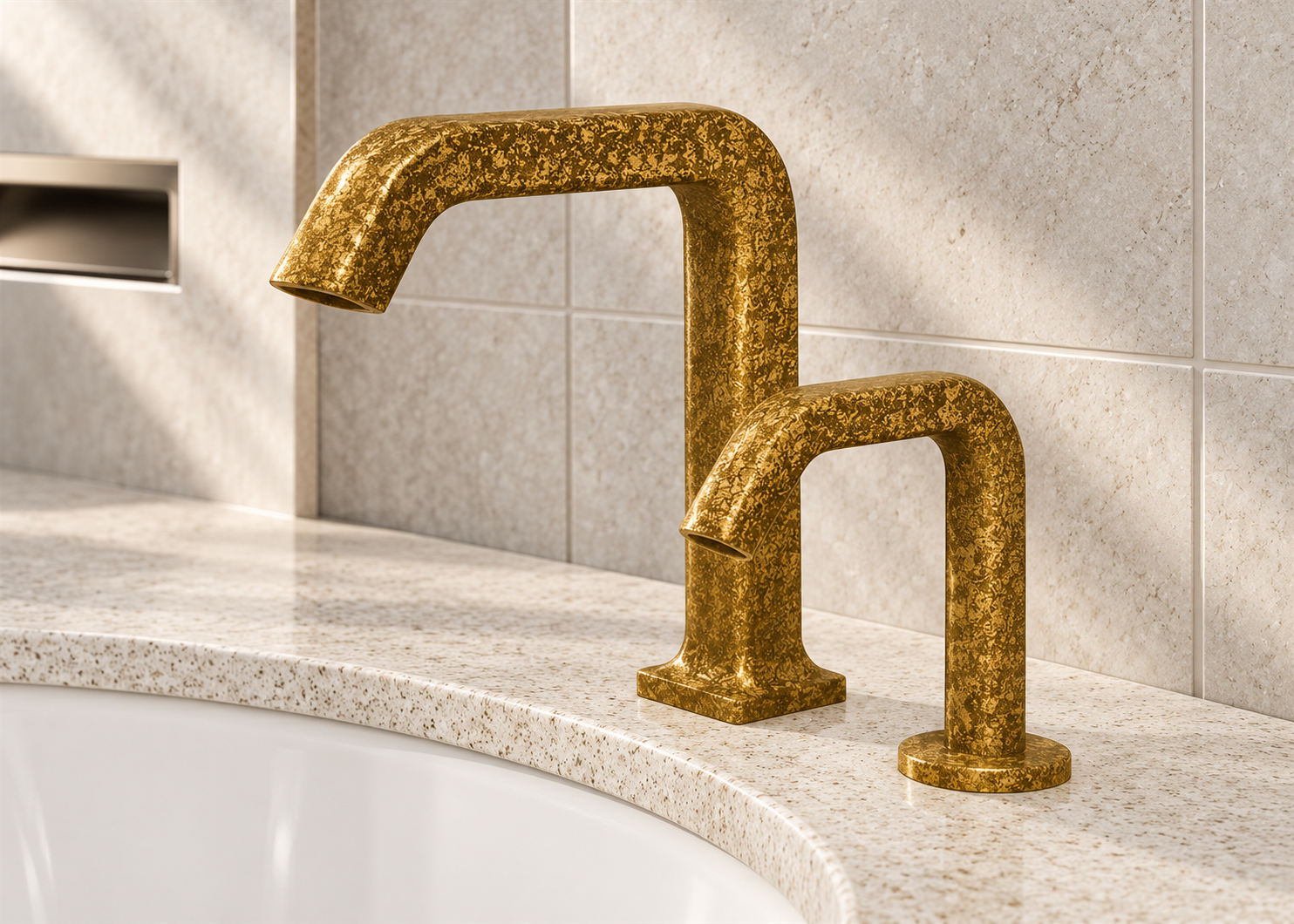
Touchless hardware should be integrated with the entire vanity composition, including basin position, controls, lighting and finishes.
Power Strategy: Battery, Hardwired and Service Access
Power architecture affects installation, maintenance frequency and the amount of equipment that must remain accessible below the counter or behind finished construction.
Battery-Powered
Useful where electrical modifications are difficult. Battery type, replacement procedures and enclosure access should be documented.
Hardwired
Can reduce routine battery changes. Transformers and replaceable controls should remain accessible for testing and replacement.
Hybrid / Backup
Where supported, specifications should state the required configuration and system behavior during primary-power interruption.
Hydraulics, Water Pressure and Faucet Flow Control
Sensor control determines when water starts and stops, but the hydraulic system determines what happens after the valve opens. Supply pressure, pressure variation, aerator condition, mixing configuration and basin geometry all influence the user experience.
Large buildings can experience pressure variation across floors, wings and peak-use periods. Commissioning should therefore verify actual fixture behavior under realistic operating conditions rather than simply confirming that water flows.
Spout and Basin Coordination
Outlet reach should place the water stream within a useful handwashing zone. A stream that lands too near the rear wall or front rim can create splash and awkward hand positioning even when the faucet itself functions correctly.
✓ Verify spout reach against basin depth.
✓ Confirm stream landing point.
✓ Check pressure at representative fixtures.
✓ Inspect strainers and aerators.
✓ Coordinate hot, cold or tempered water.
✓ Maintain serviceable isolation valves.
Large fixture banks make consistency especially important because small differences in flow, timing or sensor calibration can be repeated across many wash stations.
Water Quality, Aerators and Mineral Buildup
Touchless controls do not isolate a fixture from water-quality conditions. Sediment, scale and mineral accumulation can restrict strainers and aerators, alter spray patterns and increase maintenance frequency.
Facility teams should understand local water conditions before selecting highly restrictive outlets or maintenance-intensive components. In harder-water areas, accessible strainers and replaceable aerators become particularly important.
Commissioning documentation should establish the initial flow and spray condition so maintenance personnel have a baseline when troubleshooting future performance.
Automatic Soap Dispensers as Part of the Wash-Station System
Soap dispensing introduces a separate set of engineering and facility-management requirements. Sensor position, pump type, tubing, reservoir capacity, soap formulation and refill access influence whether the system remains consistent under daily use.
Soap Compatibility
Pump and nozzle performance should be evaluated against the intended soap formulation, viscosity and additives.
Dose Control
The system should provide a repeatable dose without unnecessary double dispensing, excessive delay or continuing drip.
Refill Architecture
Reservoir capacity should be balanced against tubing length, pump configuration and practical maintenance access.
Reservoir architecture affects refill frequency, tubing layout, maintenance access and the way multiple dispensers are supported within a restroom bank.
Preventing Common Automatic Soap Dispenser Failures
Common non-dispensing conditions include power loss, obstructed sensor windows, pump or nozzle restriction, incompatible soap and internal tubing issues.
These issues are easier to resolve when pumps, reservoirs, batteries and tubing remain accessible. Troubleshooting becomes slower when service components are hidden behind permanent finishes or obstructed by cabinetry.
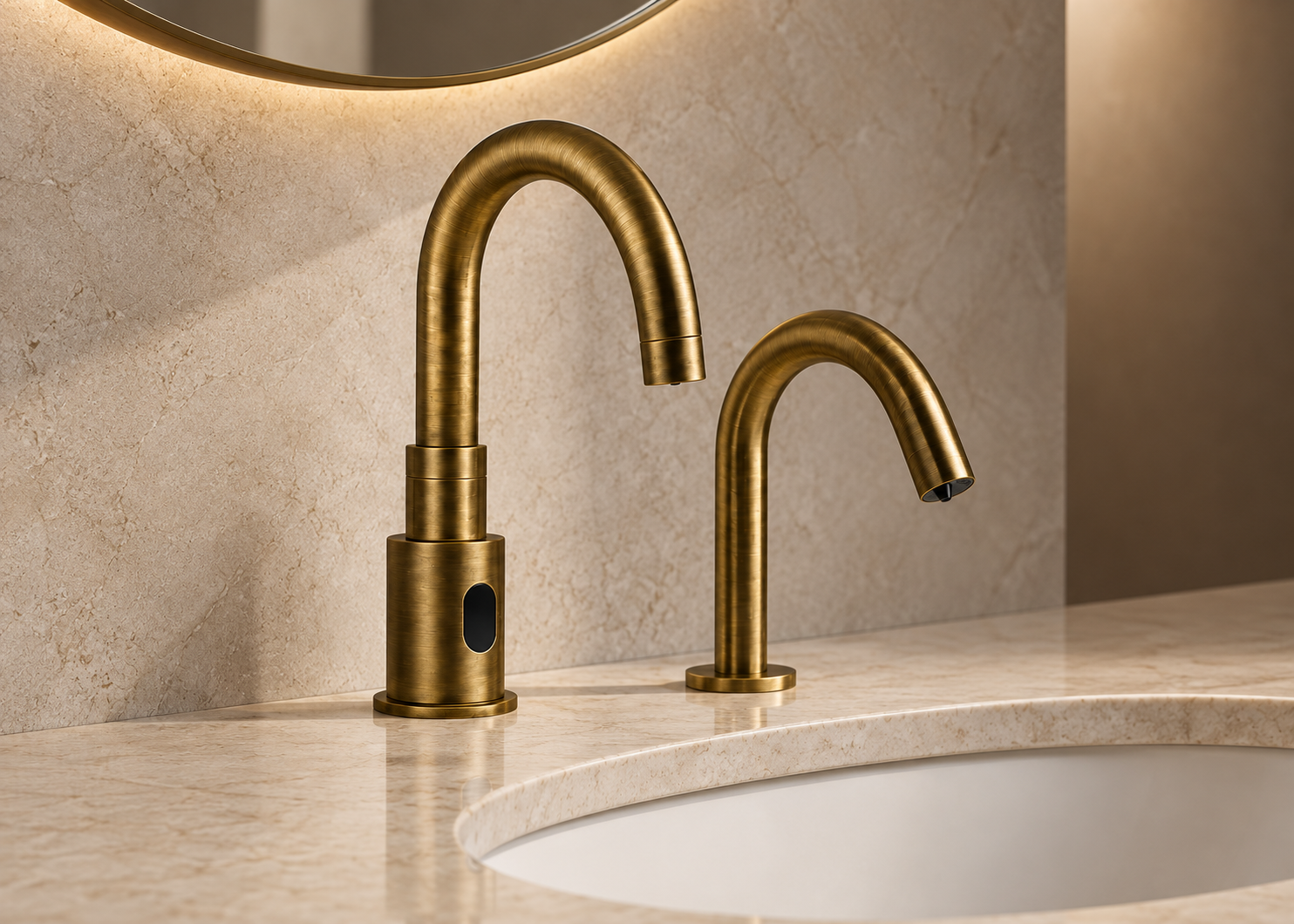
Commercial soap dispensing should be evaluated for sensing consistency, refill access, finish durability and coordination with the rest of the wash station.
Accessibility, Ergonomics and Touchless Fixture Placement
Touchless operation can reduce the need to grasp, pinch or twist a control, but automatic activation does not by itself make a restroom accessible.
The complete lavatory arrangement should coordinate approach, clear floor space, counter or lavatory configuration, knee and toe conditions, user reach, soap placement, mirrors and exposed piping.
Sensor zones should be evaluated from realistic user positions so occupants are not required to search for a narrow activation point or reach beyond the natural handwashing area.
✓ Test realistic seated and standing use positions.
Accessibility review should address the complete installed wash station rather than treating automatic sensing as an isolated accessibility feature.
Sustainability, Automatic Shutoff and Water-Use Control
Touchless fixtures can support controlled water use because the valve does not depend on the user remembering to close a handle. Automatic shutoff limits unintended run time, while the selected outlet establishes the flow delivered during operation.
Water performance should still be evaluated using verified fixture flow and actual operating conditions. Sensor timing, pressure, basin interaction, traffic pattern and commissioning can all influence the final result.
For larger facilities, engineering teams should distinguish nominal fixture flow from whole-building water performance. Supply, drainage, hot-water generation, recirculation and fixture diversity all affect the larger plumbing system.
Touchless Restroom Technology Across AEC Project Phases
Touchless systems become easier to deliver when fixture decisions are developed progressively rather than deferred until procurement.
Programming / SD
Establish Goals
Define hygiene priorities, traffic, fixture types, maintenance expectations and power implications.
Design Development
Coordinate Geometry
Confirm basin relationships, mounting, finishes, power and service zones.
Construction Documents
Lock Criteria
Identify models, flows, soap requirements, power and service provisions.
Construction / CA
Verify Installation
Review substitutions, rough-ins, electrical provisions and mounting.
Commissioning / O&M
Record Performance
Test sensing, flow, soap dose and shutoff and document baseline settings.
Commissioning Touchless Faucets and Soap Systems
Installation is not complete when the fixture first activates. Commissioning should verify the intended interaction between sensor, water, soap, basin, power and user position.
Faucet Commissioning
✓ Verify activation from intended hand position.
✓ Confirm reliable automatic shutoff.
✓ Check false activation from surrounding surfaces.
✓ Verify specified flow performance.
✓ Check stream landing and splash.
✓ Verify temperature control where applicable.
Soap Dispenser Commissioning
✓ Prime the dispensing system.
✓ Confirm repeatable dose across several cycles.
✓ Check delayed or double dispensing.
✓ Confirm clean shutoff without drip.
✓ Verify refill and service access.
✓ Record accepted settings.
Operations and Maintenance Planning
Long-term touchless-fixture performance depends heavily on whether facility teams receive clear maintenance information and practical access to serviceable components.
Buildings using many identical fixtures can benefit from standardized batteries, aerators, solenoids, sensors, soap pumps and replacement parts. Standardization also allows technicians to become familiar with a smaller number of troubleshooting procedures.
Recommended Turnover Package
✓ Exact model and product codes.
✓ Installation instructions.
✓ Sensor and controller settings.
✓ Power diagrams.
✓ Approved soap specifications.
✓ Replacement-parts list.
✓ Cleaning requirements.
✓ Commissioning results.
Touchless Restroom Specification Checklist
Specification Area
What to Define
Why It Matters
Verify During
Sensor
Technology, detection zone and adjustment requirements.
Controls false activation and missed detection.
Submittal + commissioning.
Flow
Required faucet flow and outlet configuration.
Affects consumption, wash performance and splash.
Product data + field testing.
Basin Coordination
Spout reach, outlet height and stream location.
Establishes useful handwashing geometry.
DD + mockup.
Power
Battery, AC, low-voltage or supported hybrid arrangement.
Determines rough-in and maintenance needs.
DD + electrical coordination.
Soap System
Soap type, reservoir, pump, tubing and dose.
Controls reliability and maintenance workload.
Submittal + commissioning.
Water Quality
Filtration, strainer and aerator service strategy.
Helps manage scale, sediment and restricted flow.
Plumbing design + O&M.
Accessibility
Reach, approach, clearances and operable components.
Accessibility applies to the completed installation.
Drawings + field verification.
Service Access
Access to sensors, valves, batteries, controllers and pumps.
Avoids destructive maintenance.
Coordination drawings + closeout.
Commissioning
Test sequence and acceptance criteria.
Establishes an operating baseline.
Project closeout.
How Project Teams Should Use This Guidance
Architects & Interior Designers
Coordinate fixture form, basin geometry, mounting and access panels without concealing components required for maintenance.
Plumbing & MEP Engineers
Define flow, supply conditions, temperature strategy, power, controls and service locations early.
Facility Managers
Use commissioning records as the operating baseline and standardize parts, cleaning and maintenance procedures.
Product Teams
Connect product features to verifiable sensing, flow, serviceability and compatibility criteria.
Retrofit Planning: Existing Restrooms vs. New Construction
Retrofitting an existing restroom presents constraints that a new-build project can address during design development. Before selecting a touchless faucet, survey the existing sink mounting holes, deck thickness, backsplash clearance, water-supply connections, shutoff locations and usable space beneath the basin. A fixture that fits the visible countertop may still conflict with a concealed support, drain trap, accessible knee clearance or the service envelope needed to replace a solenoid.
Electrical coordination is equally important. Battery-powered units may simplify installation where new wiring is disruptive, but facilities staff must be able to reach the battery compartment without dismantling permanent cabinetry. Hardwired systems require an appropriately located supply, protected cable routing and accessible conversion equipment. For either approach, verify the exact manufacturer’s electrical requirements rather than assuming all sensor faucets use the same voltage or connector.
For occupied buildings, plan work in phases. Identify which lavatories must remain operational, establish temporary isolation procedures and test each renovated wash station before opening it to users. Document the original and final fixture configuration, including sensor settings and spare-part references. In new construction, the same concerns should be resolved earlier through coordinated plumbing, electrical and architectural drawings.
Practical decision: choose a replacement only after checking physical fit, sensor field, plumbing compatibility, accessible reach and long-term maintenance access. This reduces the risk of a visually successful installation that performs poorly in daily operation.
Field Acceptance Testing and Measurable Results
A repeatable acceptance test is more useful than a simple pass/fail demonstration. At a representative fixture, record the installed faucet model, sensor setting, available pressure, measured outlet flow, shutoff behavior and any unexpected activation. Repeat testing with normal restroom lighting, the final basin and backsplash, and nearby fixtures in operation. Where applicable, confirm that temperature control and protective mixing devices work as designed.
For a bank of fixtures, test at least the locations most likely to expose variation: the hydraulically remote station, an end station near a reflective surface and a station next to another sensor-operated device. Check for unintended cross-activation when users approach neighboring basins. Observe whether the water stream lands inside the useful washing area without excessive splash.
Record soap-dispenser results separately. Verify the approved formulation, prime the system according to the manufacturer’s instructions, then assess dose consistency and nozzle drip over several activations. A dispenser may detect hands correctly while delivering inconsistent soap because of pump, tubing or viscosity problems. Give facilities staff the accepted settings, service instructions and a clear escalation path for faults.
These measurements provide a baseline for later maintenance. When complaints occur, technicians can compare current behavior with commissioning records instead of relying on subjective impressions. Acceptance criteria should always reflect the selected equipment, the project specification and applicable local requirements.
Put This Engineering Guide to Work
Start with the specification checklist, then use the related technical articles to investigate sensor selection, water consumption and dispenser maintenance before finalizing a restroom design.
Related WikiHomeImprovements Touchless Technology Guides
These related resources provide deeper coverage of sensor selection, touchless-faucet water performance and soap-dispenser troubleshooting.
Sensor Engineering
Infrared vs. Time-of-Flight Sensors for Automatic Faucets
Compare conventional infrared proximity sensing with Time-of-Flight distance measurement, including reflectivity, activation zones, false triggering and field commissioning considerations.
How to Fix a Touchless Soap Dispenser That Will Not Dispense
Troubleshoot power problems, sensor contamination, soap compatibility, nozzle restriction, tubing conditions and internal dispensing faults using a practical maintenance sequence.
Review touchless-faucet water-use considerations, automatic shutoff, flow control and the relationship between commercial fixture settings and overall restroom performance.
Why do automatic faucets sometimes activate by themselves?
Possible causes include excessive sensing range, reflective basin or drain surfaces, neighboring fixtures, moisture on the sensor window, incorrect aiming or calibration problems.
Is Time-of-Flight always better than infrared sensing?
Not necessarily. Both approaches can support reliable operation. ToF adds distance information, while reflective infrared can perform effectively when correctly designed and commissioned.
What usually causes an automatic soap dispenser to stop dispensing?
Common causes include depleted power, a contaminated sensor window, clogged pump or nozzle components, unsuitable soap viscosity, tubing problems or internal mechanical faults.
Why should touchless fixtures be commissioned?
Commissioning confirms that sensing, flow, automatic shutoff, soap dose and service access work under actual installed conditions rather than only under factory conditions.
Should faucets and soap dispensers be specified independently?
They can be separate products, but they should be coordinated as one wash-station system because basin geometry, sensor fields, mounting, power and maintenance access interact.
Representative Touchless Product and Manufacturer References
These manufacturer pages remain useful as representative examples of the broader touchless-fixture landscape. Product-specific technical data should be confirmed against current manufacturer documentation during specification.
Designing Touchless Restrooms for Long-Term Performance
As expectations for restroom hygiene, accessibility, water management and operational reliability continue to develop, touchless fixture specifications should place greater emphasis on repeatable field performance rather than the presence of electronics alone.
Strong systems combine appropriate sensing, robust mechanical components, coordinated basin geometry, accessible service zones and clear maintenance documentation.
For AEC teams, the most useful question is not simply which touchless fixture to select. It is how the complete wash station should perform, how that performance will be verified and how the facility will maintain it over time.