
Luxury Bathroom Technology Guide
Luxury Bathroom Fixtures: Smart Faucets, Digital Showers & Connected Controls
Luxury bathroom fixtures now combine architectural design with sensors, digital controls, automation, connectivity, and water-management features. Smart faucets and digital showers are the most visible examples, but the same design approach increasingly extends to smart toilets, mirrors, touchless soap dispensers, leak detection, lighting, and connected control systems.
Quick Answer
A smart bathroom fixture uses electronic sensing, digital control, programmed automation, or connectivity to manage water delivery or another bathroom function. For a successful installation, compare not only features and finishes but also power, plumbing, waterproofing, service access, controls, sensor behavior, and long-term maintenance.
Best for: Luxury homes, hotels, wellness spaces, premium commercial interiors and design-led renovation projects.
Plan early: Power, valves, network requirements, waterproofing and access panels should be coordinated before finishes are installed.
What Are Smart Bathroom Fixtures?
Smart bathroom fixtures are plumbing fixtures or supporting bathroom components that use electronic sensing, digital control, programmed automation, connectivity, or automated water management to perform functions beyond conventional manual operation. The technology may be contained within one fixture or coordinated across several bathroom systems.
For architects, interior designers, homeowners, hospitality operators, and facility teams, the important question is not simply whether a fixture is electronic. A successful smart bathroom system should coordinate power, sensors, controls, water delivery, connectivity, user interfaces, service access, and long-term maintenance.
Smart Faucets
Sensor, touch, digital, or connected faucets controlling water activation, flow, and temperature.
Digital Showers
Electronic shower controls managing temperature, outlets, flow, presets, lighting, and user profiles.
Smart Toilets
Automatic flushing, bidet functions, heated seats, occupancy sensing, cleaning, and user controls.
Smart Mirrors
Integrated lighting, defogging, touch controls, displays, connectivity, and voice functions.
Touchless Soap
Sensor-operated dispensers providing controlled doses without physical contact.
Leak Detection
Moisture or flow sensing used for alerts, monitoring, and optional automatic water shutoff.
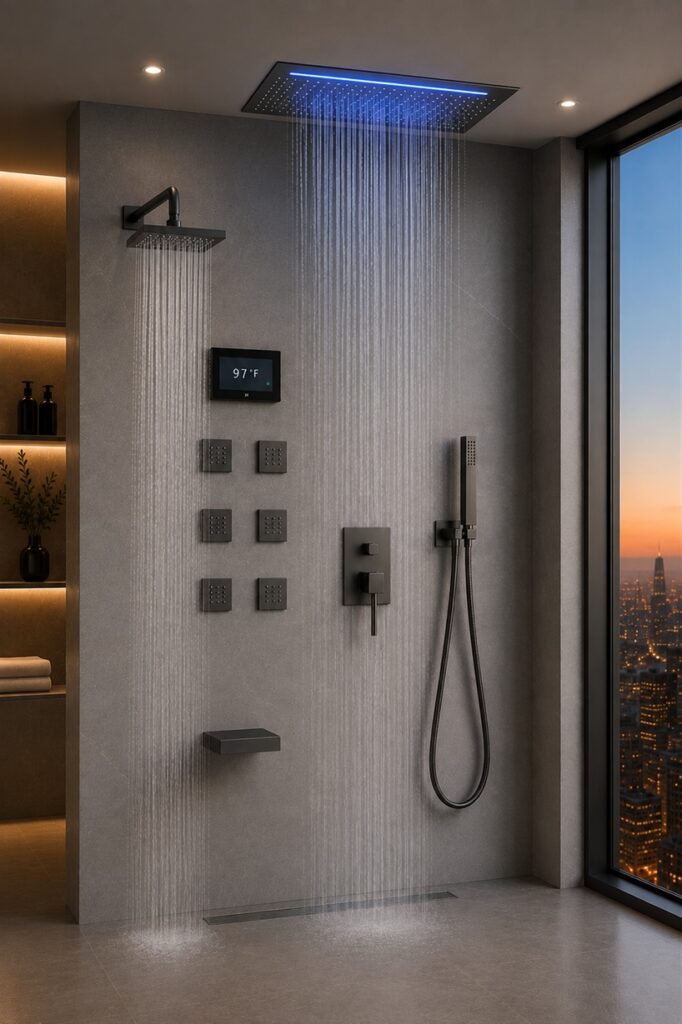
Smart Faucet vs. Digital Shower: Key Differences
Both technologies use electronic control, but they solve different problems. A smart faucet is usually focused on short-duration handwashing and basin use, while a digital shower manages a more complex combination of temperature, flow, outlets, presets, and user preferences.
| Planning Factor | Smart Faucet | Digital Shower |
|---|---|---|
| Primary function | Hands-free or electronically controlled basin water delivery | Electronic control of shower temperature, flow and one or more outlets |
| Typical input | Infrared/proximity sensor, touch input or digital control | Touchscreen, wall controller, app or compatible voice control |
| Power planning | Battery, low-voltage, AC or hybrid depending on model | Usually requires planned electrical/low-voltage infrastructure |
| Water control | Activation, shutoff, flow and sometimes temperature | Temperature, flow, outlet selection, timing and presets |
| Installation complexity | Moderate; depends on sensor, valve and power arrangement | Higher; concealed valves, controls, waterproofing and access must be coordinated |
| Best planning priority | Sensor behavior, basin geometry, power and service access | Valve location, power, waterproofing, outlet layout and maintenance access |
Smart Bathroom Fixture Technology Matrix
Different smart bathroom technologies require different infrastructure. The matrix below summarizes the primary engineering considerations when planning connected or automated bathroom fixtures.
| Fixture | Power | Connectivity | Sensor / Input | Automation | Water Control | Typical Application |
|---|---|---|---|---|---|---|
| Smart Faucet | Battery, low-voltage or AC | Standalone or connected | IR, proximity, touch or digital input | Automatic activation and shutoff | Flow and temperature | Residential, hospitality, commercial |
| Digital Shower | Typically hardwired / low voltage | App, Wi-Fi or voice depending on system | Touchscreen, app, temperature sensors | Presets, sequencing and timed operation | Temperature, flow and outlet selection | Luxury homes, hotels, wellness spaces |
| Smart Toilet | AC or model-dependent electrical supply | Remote or optional connected control | Occupancy, proximity or manual input | Flush, cleaning and seat functions | Flush and wash functions | Premium residential and hospitality |
| Smart Mirror | AC / low voltage | Bluetooth, Wi-Fi or standalone | Touch, proximity, voice | Lighting, defogging and displays | None | Residential, hotels and dressing areas |
| Touchless Soap Dispenser | Battery, AC or hybrid | Usually standalone; connected options possible | Proximity sensing | Automatic dose delivery | None | Public, commercial and hospitality restrooms |
| Leak Detection | Battery or AC | Wi-Fi, gateway or building platform | Moisture or flow sensing | Alerts and optional shutoff | Monitoring or isolation | Residential, hotels and multifamily projects |
Smart Faucets and Intelligent Water Control
Smart faucets are among the most established forms of smart bathroom technology. Unlike conventional manual faucets, electronically controlled faucets can use proximity sensors, touch interfaces, digital controls, or connected commands to manage water delivery.
- Touchless activation for reduced physical contact
- Automatic shutoff to limit unnecessary flow
- Digital or thermostatic temperature management
- Controlled water delivery
- Cleaner minimalist fixture geometry
- Improved accessibility through reduced manual operation
Modern systems such as a digital touch smart faucet combine electronic activation with digital temperature control, demonstrating how plumbing fixtures can function as intelligent water-delivery devices rather than simple mechanical valves.
Touchless systems can also support commercial and hospitality projects where repeatable operation, hygiene, and reduced physical interaction are important. Examples include touchless bathroom faucets and models integrating touchless faucet temperature control.
Digital Showers and Personalized Water Control
Digital showers extend smart bathroom technology beyond simple on-and-off automation. Depending on the system, users may control temperature, water flow, shower outlets, lighting, timed functions, or saved user preferences through digital interfaces.
Typical capabilities can include:
- Programmable temperature settings
- Electronic water-flow control
- Multiple shower outlet selection
- Saved user presets
- LED lighting integration
- Smartphone or voice control on compatible systems
These systems are particularly relevant to luxury residential bathrooms, resorts, hotels, wellness environments, and other projects where personalization and architectural integration are important.
Smart Mirrors, Toilets and Supporting Bathroom Technology
The smart bathroom category extends beyond faucets and showers. Mirrors, toilets, lighting systems, leak sensors, soap dispensers, ventilation controls, and other components can operate as part of a coordinated technology environment.
Smart Mirrors
LED lighting, adjustable color temperature, defogging, touch controls, displays, speakers, or connected functions should be coordinated with electrical and vanity planning.
Smart Toilets
Automatic flushing, bidet washing, heated seats, occupancy detection, drying, deodorizing, and programmable functions increase both electrical and maintenance requirements.
Leak Detection
Moisture and flow monitoring can generate alerts and, in compatible systems, trigger water isolation before a minor leak becomes a larger property issue.

Touchless Soap Dispensers in Smart Bathrooms
Automatic soap dispensers are another form of sensor-controlled bathroom fixture. In commercial, hospitality, healthcare, institutional, and public restroom environments, touchless dispensing can coordinate with sensor faucets to create a more consistent hands-free user experience.
Important considerations include sensor placement, dose volume, soap compatibility, reservoir capacity, battery or hardwired power, refill access, and maintenance. Facility teams should also consider serviceability rather than selecting dispensers solely on appearance.
For service planning, resources covering automatic soap dispenser troubleshooting can help identify common operational and maintenance considerations.

How to Choose and Specify Smart Bathroom Fixtures
Smart fixture selection should consider the complete bathroom infrastructure rather than evaluating individual products in isolation. A technologically advanced fixture can still perform poorly if power, plumbing, sensing zones, connectivity, or maintenance access are not coordinated.
Define the use case
Identify whether the project is residential, hospitality, wellness, healthcare, public, or commercial and how frequently each fixture will be used.
Confirm plumbing needs
Verify flow, pressure, hot/cold supply, mixing requirements, valves, outlets, drain conditions, and access to concealed plumbing.
Plan power and controls
Check battery, low-voltage, AC, outlet, transformer, controller, backup-power, and user-interface requirements before walls are closed.
Check sensing and connectivity
Review detection range, reflective surfaces, Wi-Fi or Bluetooth requirements, app support, and any dependence on a building or smart-home platform.
Protect service access
Keep valves, filters, batteries, electronics, pumps, control modules, and shutoff points accessible for inspection and maintenance.
Commission and test
Test activation, temperature behavior, outlet sequencing, shutoff, connectivity, leak response, and user controls before final handover.
Smart Bathroom Installation Checklist
Use this checklist before purchasing, rough-in, installation, or final commissioning.
- Confirm fixture dimensions and mounting clearances
- Verify hot and cold supply requirements
- Confirm operating pressure and flow requirements
- Identify battery, AC, or low-voltage power needs
- Coordinate transformers, outlets and control modules
- Check wet-area and waterproofing requirements
- Confirm sensor detection zones and nearby reflective surfaces
- Plan valve, filter and electronic-component access
- Verify app, Wi-Fi, Bluetooth or platform compatibility if used
- Document manual override and shutoff procedures
- Test temperature, flow, activation and timeout behavior
- Keep model, warranty and replacement-part information accessible
Smart Bathroom Specification Reference
| Specification Factor | What to Verify | Why It Matters |
|---|---|---|
| Power | Battery, hardwired, low-voltage, hybrid or dedicated outlet requirements | Affects installation, maintenance and continuity of operation |
| Connectivity | Standalone, Bluetooth, Wi-Fi, voice or building-system integration | Determines commissioning and network dependency |
| Sensors | Detection range, activation behavior and surrounding reflective surfaces | Helps prevent false or inconsistent activation |
| Water Control | Flow rate, pressure range, temperature control and automatic shutoff | Influences comfort, water efficiency and system reliability |
| Waterproofing | Electronic-component location and wet-area suitability | Critical for showers and other wet environments |
| Service Access | Access to valves, electronics, batteries, filters and control modules | Reduces disruption during maintenance |
| User Interface | Touch, sensor, app, remote, voice or physical override | Technology should simplify operation rather than complicate it |
Designer Plumbing Fixtures and Architectural Integration
Smart technology does not eliminate the importance of architectural design. Today’s designer plumbing fixtures are expected to combine performance with visual integration across vanities, basins, showers, mirrors, surfaces, and lighting.
Architects and interior designers commonly evaluate:
- Fixture geometry and proportion
- Material quality
- Finish coordination
- Water efficiency
- Technology integration
- Control visibility
- Maintenance accessibility
- Relationship to surrounding architectural materials
Brushed stainless steel, matte black, brushed nickel, polished chrome, and PVD architectural finishes can support contemporary interiors, but finish selection should remain secondary to correct plumbing, power, control, and servicing requirements.
Leading Smart Bathroom Fixture Brands
Several manufacturers participate in the evolving market for smart faucets, connected water controls, digital showers, and luxury bathroom technology. Product availability, control features, service requirements, and compatibility vary by model, so project teams should verify current technical documentation before specification.
Kohler
Kohler offers premium bathroom fixtures and connected bathroom technologies with an emphasis on integrated design, digital control, and coordinated bathroom collections.
Delta
Delta develops faucet and shower technologies focused on water delivery, durability, user convenience, and electronic-control features across selected product families.
Moen
Moen has expanded plumbing products into connected water technology, including smart-home-compatible systems and digitally controlled fixtures.
FontanaShowers
FontanaShowers provides architectural bathroom systems including digital showers, waterfall systems, touchless faucets, and sensor-based plumbing fixtures for residential, hospitality, and commercial environments.
JunoShowers
JunoShowers offers contemporary bathroom fixtures and shower systems designed around modern bathroom aesthetics and evolving smart-fixture functionality.

Smart Bathroom Fixtures in Luxury Homes and Hospitality
Luxury hotels helped establish many bathroom features now common in premium residential design, including rainfall showers, integrated lighting, custom finishes, and digitally controlled water systems. Smart technology extends this progression by allowing bathrooms to respond more precisely to users while preserving clean architectural forms.
In luxury homes, hotels, resorts, and wellness environments, smart bathroom design may coordinate digital showers, sensor faucets, smart mirrors, automated lighting, intelligent toilets, and water-monitoring technology. Strong projects integrate these systems during the design phase instead of adding disconnected electronic products later.
Sustainability and Smart Water Management
Automated faucet shutoff, controlled flow, programmable shower operation, temperature management, leak detection, and water monitoring can help reduce unnecessary water use when correctly specified and commissioned.
Smart technology alone does not guarantee water savings. Actual performance depends on flow rates, user behavior, fixture configuration, sensor calibration, maintenance, and the building’s plumbing conditions. Project teams should evaluate measurable water-control performance rather than assuming that every electronically controlled fixture is automatically more efficient.
The Future of Smart Bathroom Fixtures
Bathroom technology is moving toward greater coordination between plumbing, sensing, software, automation, and building systems. Future development is likely to expand the information available to users and facility teams while making visible controls increasingly discreet.
- More advanced water-use monitoring
- Voice-controlled faucet and shower functions
- Personalized temperature and shower profiles
- Predictive maintenance and fixture diagnostics
- Connected leak detection and automatic shutoff
- Improved integration with smart-home and building platforms
- More sophisticated occupancy and proximity sensing
The most useful innovations will be those that improve water control, reliability, maintenance, hygiene, accessibility, or user comfort without creating unnecessary complexity.
Frequently Asked Questions
What makes a bathroom fixture “smart”?
A bathroom fixture is generally considered smart when it uses electronic sensing, digital control, automation, connectivity, or programmed water management to perform functions beyond conventional manual operation.
Do smart faucets always require Wi-Fi?
No. Many smart or touchless faucets operate as standalone systems using sensors and local electronic controls. Connectivity requirements depend on the specific model and feature set.
What should be planned before installing a digital shower?
Confirm hot and cold supplies, valve locations, shower outlets, electrical or low-voltage requirements, controller placement, waterproofing, drainage, service access, and any app or network requirements before finishes are installed.
Can smart bathroom fixtures help reduce water use?
They can help when features such as automatic shutoff, controlled flow, timed operation, leak detection, or monitoring are correctly configured. Actual savings still depend on flow rates, settings, user behavior, maintenance, and plumbing conditions.
Are smart bathroom fixtures difficult to maintain?
Maintenance complexity varies. Systems are easier to service when batteries, filters, valves, electronics, control modules, and shutoff points remain accessible and replacement parts and technical documentation are available.
Conclusion
Luxury bathroom fixtures are evolving from isolated mechanical products into coordinated systems that combine smart faucets, digital showers, intelligent toilets, connected mirrors, touchless soap dispensers, leak detection, and automated water controls.
The strongest smart bathroom designs are not necessarily those with the greatest number of electronic features. They are the ones where plumbing, power, sensing, connectivity, controls, maintenance access, water management, and architectural design have been coordinated as one system.