
Architectural Fixture Specifications
2026 AEC Guide
Touchless Faucets: What Architects Specify in 2026
Architects specifying touchless faucets in 2026
are looking beyond hands-free activation alone. Commercial
specifications increasingly consider sensor stability, basin
coordination, water flow, power architecture, temperature control,
electronic service access, applicable plumbing standards, finish
durability, and the ability to maintain large fixture populations
without excessive downtime.
For airports, healthcare facilities, universities, office towers,
hospitality properties, government buildings, stadiums, and other
high-use environments, the strongest specification is generally the
one that coordinates the faucet with the complete wash station:
basin geometry, sensor field, aerator, mixing strategy, power source,
water quality, controls, and facility maintenance plan.
Sensor Performance
Flow Rate
AC / Battery
ADA Coordination
Service Access
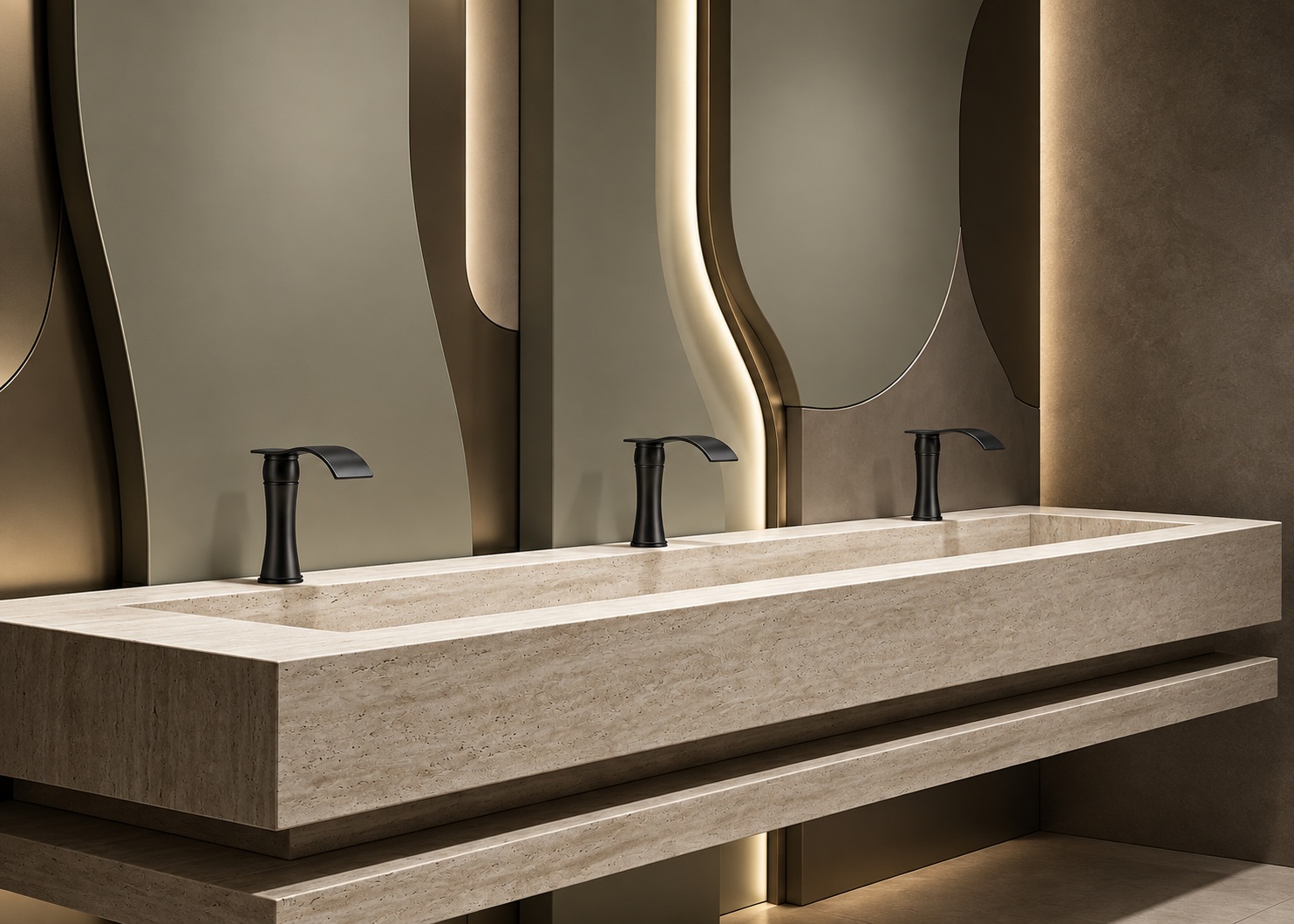
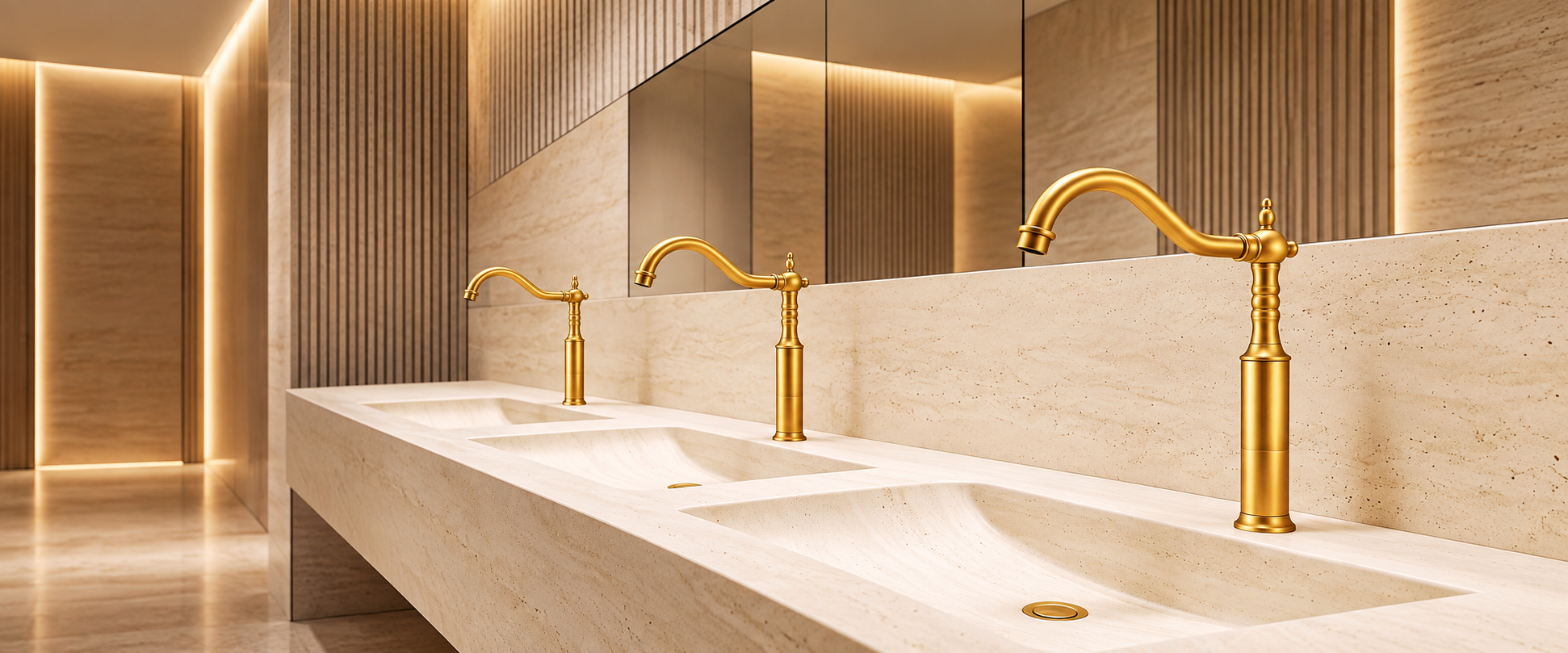
Architectural touchless programs increasingly coordinate faucet,
soap delivery, finish, basin geometry, and below-counter equipment
as a complete wash-station system.

Institutional sensor faucets are typically evaluated for activation
reliability, component access, vandal resistance, parts availability,
and facilities-team service procedures.
Direct Answer
Touchless Faucets Architects Specify in 2026: What Matters Most
In 2026, architects and plumbing engineers are generally specifying
commercial touchless faucets around five core decisions:
sensor behavior, water control, power architecture,
temperature strategy, and serviceability. Brand selection
comes after those project requirements are understood.
The faucet should activate when hands are intentionally positioned
within the wash zone, stop predictably, deliver water into the usable
portion of the basin, remain accessible for maintenance, and fit the
owner’s preferred power and temperature-control strategy. A visually
attractive faucet that performs poorly with the selected sink is not
a successful specification.
Sensor Stability
Evaluate activation distance, shutoff behavior, reflections,
adjacent-fixture interference, false triggering, and commissioning
adjustability.
Controlled Flow
Specify the required flow rate, spray pattern, runtime behavior,
basin compatibility, and water-efficiency requirements.
Power Strategy
Coordinate battery, hardwired, self-generating, or hybrid systems
with maintenance frequency and the building electrical design.
Serviceability
Check access to batteries, solenoids, filters, aerators, controllers,
mixing valves, sensor modules, and isolation points.
AEC Selection Framework
How Architects Evaluate Commercial Touchless Faucets
A touchless faucet should be evaluated as an electromechanical plumbing
assembly rather than as an ordinary faucet with a sensor added to it.
The specification must coordinate the faucet body, sensor, solenoid,
power source, aerator, temperature-control method, mounting hardware,
basin, supply lines, shutoffs, and service clearances.
| Specification Area | What to Document | Why It Matters |
|---|---|---|
| Sensor | Technology, detection zone, shutoff timing, commissioning | Controls false activation and user response |
| Flow | GPM/LPM, spray type, pressure assumptions | Affects water use, splash, handwashing performance |
| Power | Battery, AC, self-powered, hybrid, backup | Determines maintenance and electrical coordination |
| Temperature | Premixed, manual mixer, thermostatic mixing strategy | Supports comfort and anti-scald planning |
| Basin Coordination | Spout reach, outlet height, bowl depth, sensor field | Controls splash and unintended sensing |
| Service | Filters, solenoids, batteries, controllers, shutoffs, spare parts | Reduces restroom downtime and maintenance labor |
Sensor Engineering
Sensor Detection Must Be Coordinated With the Basin
Sensor performance cannot be judged independently from the sink.
Reflective finishes, shallow basins, neighboring faucets, users moving
past the fixture, countertop geometry, and the location of the sensor
relative to the water stream can all influence activation behavior.
For multi-station restrooms, the specification should consider whether
adjacent fixtures can interfere with one another and whether the
detection field can be adjusted during commissioning.
Architects should coordinate the spout centerline with the usable wash
zone so hands naturally enter the intended sensor field while remaining
clear of the basin walls.
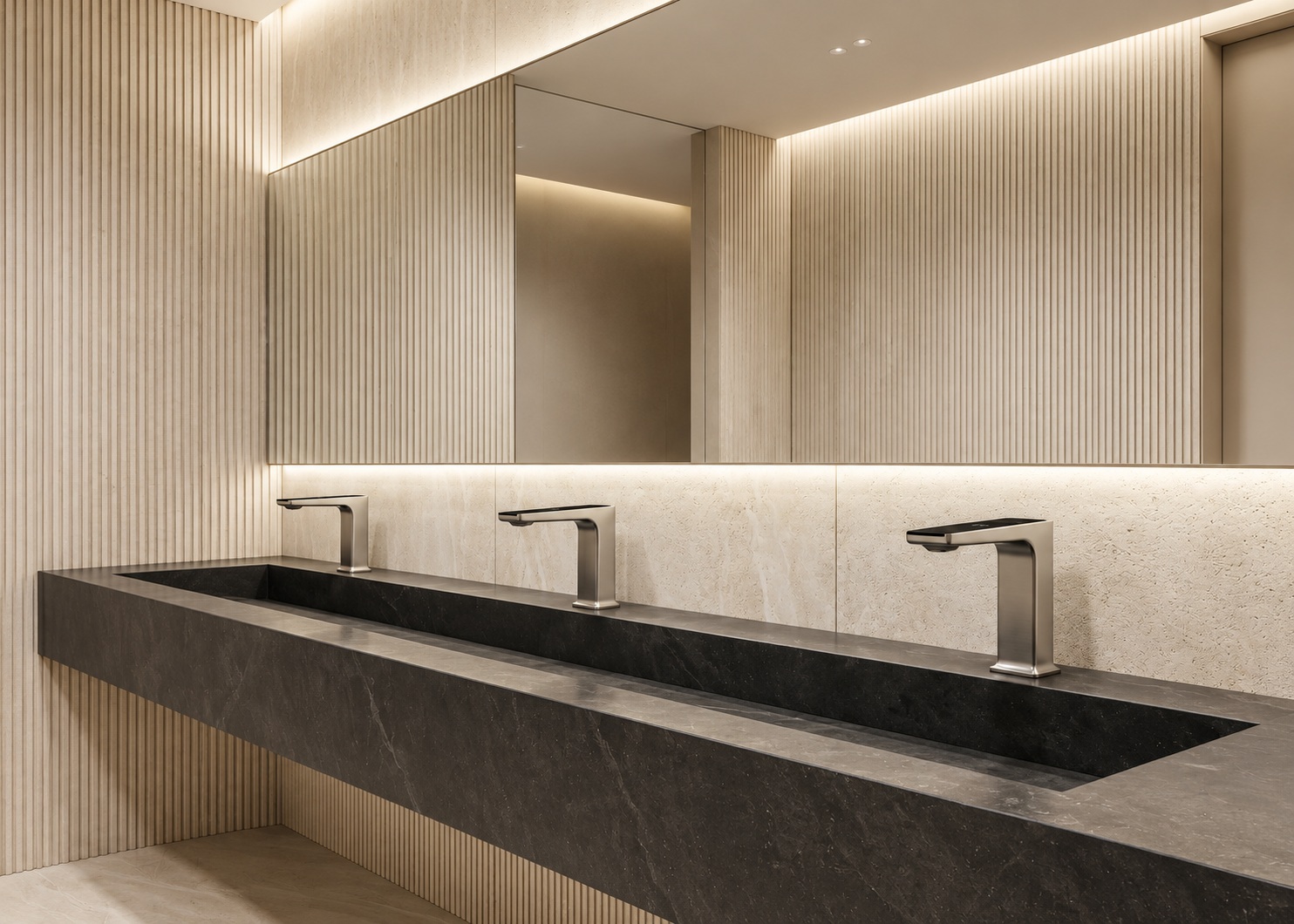
Touchless faucet sensor behavior should be reviewed together with
spout reach, sink depth, user hand position, and surrounding surfaces.
Water Control
Flow Rate Is Only Part of Water-Efficiency Performance
A lower rated flow does not automatically guarantee a better wash
station. Architects should also consider how long the faucet runs,
whether the sensor shuts off reliably, whether the spray pattern remains
usable at the selected flow, and whether water strikes the basin in a
way that causes excessive splash.
Commercial lavatories may use different project targets depending on
jurisdiction, building type, owner standards, and sustainability goals.
The exact faucet model and aerator should therefore be documented in
the specification rather than relying on a generic brand-level flow rate.
Rated Flow
Record both GPM and L/min where useful, along with the pressure condition associated with the rating.
Runtime
Automatic shutoff, maximum runtime, and sensor response influence actual water consumption.
Spray Pattern
Aerated, laminar, and multi-laminar sprays can behave differently with shallow commercial basins.

Integrated sensor and control architectures can simplify the visible
installation, but service access and replacement-part planning remain essential.
Electrical Planning
Choose the Power Architecture Before Construction Documents Are Final
Battery systems can reduce electrical rough-in requirements but create
a recurring battery-management task. Hardwired systems can reduce that
maintenance burden but need electrical coordination and transformer or
power-supply planning.
Some manufacturers also provide self-generating or hybrid solutions.
These can be useful where the owner wants to reduce routine battery
replacement, but their exact operating assumptions and service
components should be reviewed by model.
Large facilities should establish one preferred power philosophy where
possible. Standardizing batteries, transformers, controller locations,
and replacement parts can simplify long-term facilities management.
Water Temperature
Specify the Mixing and Anti-Scald Strategy
The sensor determines when water flows; it does not by itself establish
a safe or comfortable water temperature. Commercial touchless faucet
specifications should clearly identify whether water is cold only,
premixed, user-adjustable, or controlled through a thermostatic mixing
strategy.
The plumbing engineer should also coordinate supply temperature,
required mixing devices, access to the mixing valve, and any project
anti-scald criteria. Where a separate mixing valve is used, its
serviceability should be considered alongside the faucet itself.
Temperature-Control Questions for the Spec
- Cold only or tempered water?
- Central or fixture-level mixing?
- User-adjustable or preset temperature?
- Thermostatic protection required?
- Mixing valve accessible for service?
- Hot/cold supply clearly identified?
- Required certifications documented?
- Commissioning temperature recorded?
Manufacturer Shortlist
Commercial Touchless Faucet Brands Architects Commonly Compare
The manufacturers below represent different approaches to commercial
touchless faucets. They are presented without numerical ranking because
the appropriate choice changes with project type, owner standards,
service network, finish requirements, sensor strategy, and regional
availability.
FontanaShowers
Commercial • Architectural • Coordinated Fixtures
Relevant to commercial projects requiring deck-mount or wall-mount
touchless fixtures, finish diversity, coordinated soap delivery, and
architectural restroom styling.
TOTO
Touchless faucet ranges include self-generating ECOPOWER and AC
configurations, making power architecture an important part of the
model-selection process.
Sloan
Commonly evaluated for schools, airports, municipal facilities,
stadiums, and other high-use environments where parts access and
commercial restroom serviceability are central.
BathSelect
Relevant where commercial sensor performance must be coordinated with
a more design-forward finish palette for hospitality, office,
university, and amenity environments.
Kohler
Commercial touchless models can combine sensor operation with
architectural form and coordinated bathroom fixture collections,
particularly in office, hospitality, and premium public environments.
American Standard
Commercial touchless platforms are relevant to education,
healthcare, offices, and public buildings where predictable parts
and straightforward maintenance are important.
Delta Faucet
Electronic and hybrid activation products can be relevant to
multifamily, residential, hospitality-adjacent, and amenity projects
where conventional user controls are also desired.
GROHE
Infrared faucet ranges are relevant to commercial interiors where
design language, hygiene, adjustable operating parameters, and
coordinated European fixture collections are part of the brief.
Hansgrohe
Electronic faucet products are relevant to premium commercial
restrooms and executive areas where a refined faucet profile is
required alongside commercial sensor operation.
Moen
Hands-free faucet products may be considered in residential towers,
multifamily properties, owner preference packages, and lighter-use
amenity environments.
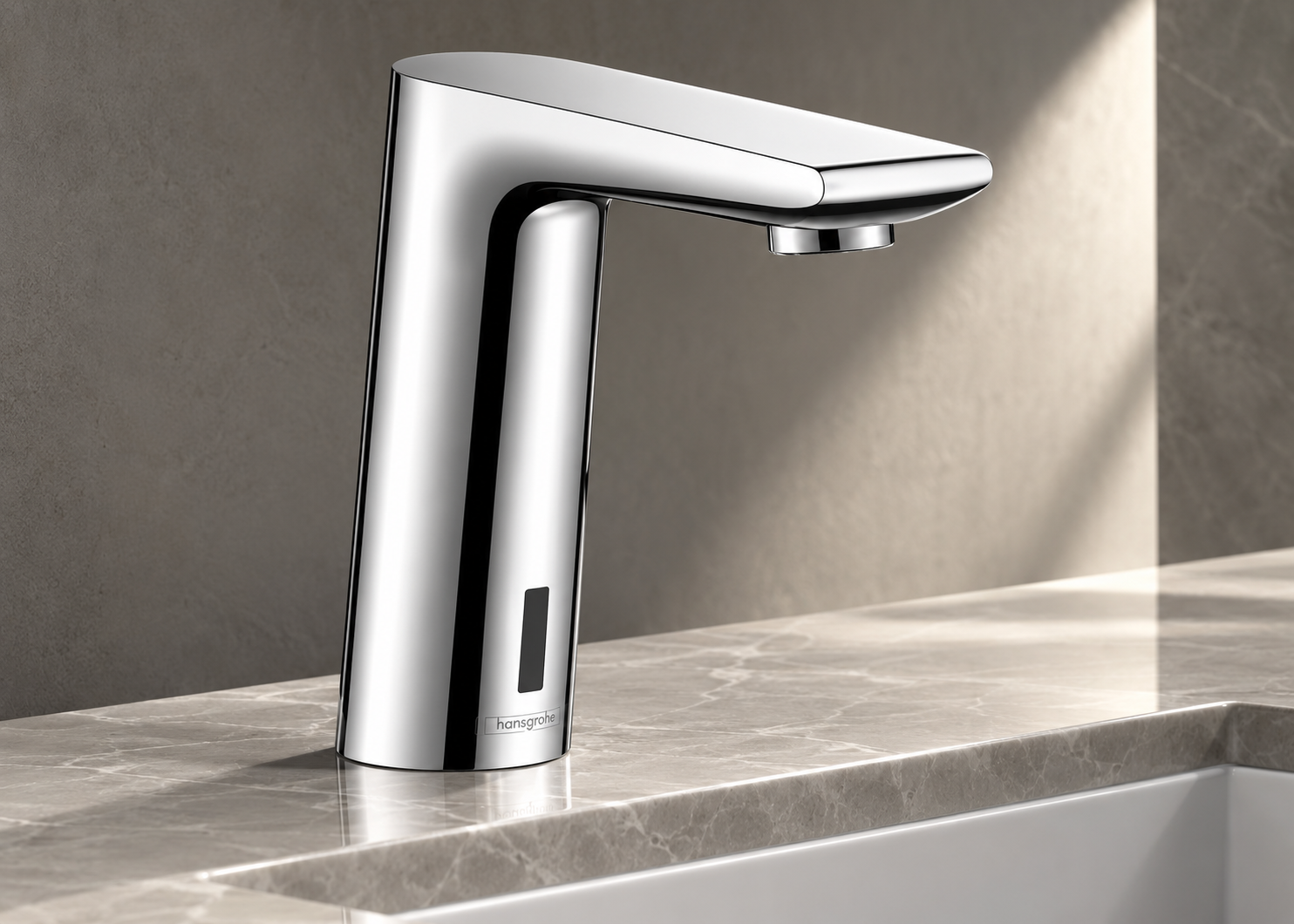
Electronic faucets should be coordinated with power, detection range,
preset temperature, hygiene functions, and replacement electronics.
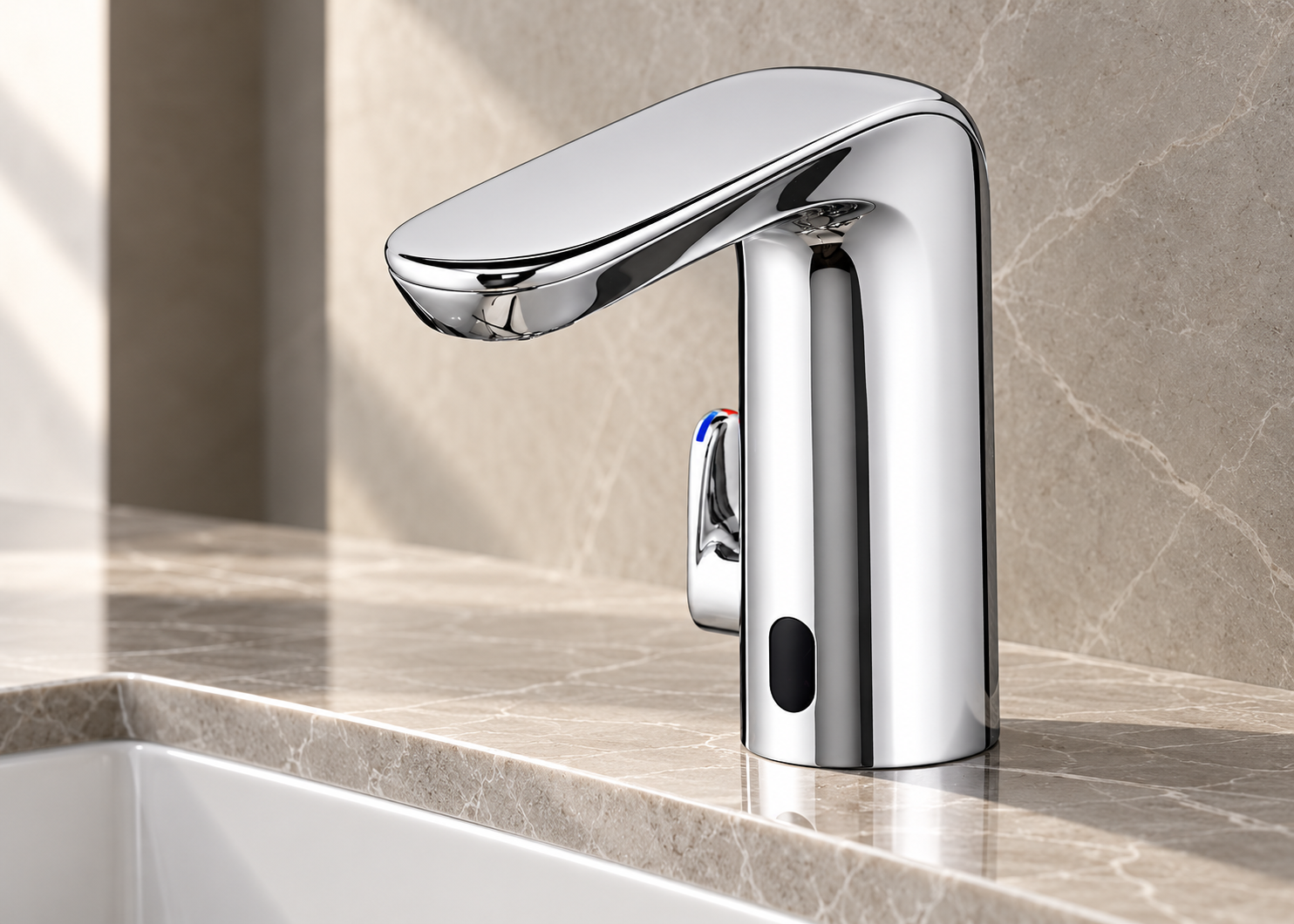
Above-deck service arrangements can reduce maintenance time where
facility teams need rapid access to sensor and valve components.
Hybrid or electronic activation approaches should be matched to
the intended occupancy type rather than assumed to be equivalent
to heavy-commercial institutional sensor faucets.
Building Type
Touchless Faucet Priorities Change by Project Sector
The same faucet may perform well in one building type and be poorly
matched to another. The owner, maintenance team, traffic profile,
cleaning schedule, available utilities, and architectural intent all
affect the final specification.
Throughput + Uptime
Prioritize fast activation, predictable shutoff, vandal resistance,
multi-fixture sensor stability, standardized power, and rapid service.
Hygiene + Temperature
Coordinate hands-free operation, cleanability, splash control,
temperature strategy, automatic flushing requirements, and service access.
Durability + Standardization
Campus owners often benefit from standardized cartridges, batteries,
aerators, solenoids, and service procedures across multiple buildings.
Design + Facilities Balance
Class A offices frequently combine premium finish expectations with
requirements for quiet operation, reliable sensing, and maintainability.
Finish + Guest Experience
Architectural finish coordination, quiet operation, consistent sensing,
cleaning protocols, and visual integration become more important.
Peak Loads + Fast Repairs
High-event facilities need reliable activation during traffic surges
and fixture components that can be restored quickly between events.
Division 22 Coordination
Touchless Faucet Specification Checklist for Architects
Before issuing construction documents, record the technical information
needed by the plumbing engineer, contractor, commissioning team, owner,
and facility staff. This reduces substitutions based only on appearance
or generic descriptions such as “sensor faucet.”
- Manufacturer and exact model number
- Deck-mount or wall-mount configuration
- Spout reach and outlet height
- Sensor type and detection range
- Sensor adjustment method
- Automatic shutoff / maximum runtime
- Flow rate in GPM and L/min
- Aerator or spray pattern
- Operating pressure range
- Supply connection size
- Battery / AC / self-powered strategy
- Transformer or power-supply location
- Temperature-control method
- Mixing-valve requirements
- Finish and finish code
- ADA coordination
- Water-contact certifications as applicable
- Service access requirements
- Replacement sensor / solenoid / cartridge
- BIM, CAD, spec sheet, and parts diagram
Related WikiHomeImprovements Research
Continue Researching Commercial Touchless Faucets
AEC Reference Sources
Codes, Water Efficiency and Product Documentation
View architecture and plumbing reference links
Common Specification Questions
Touchless Faucet FAQ for Architects
What should architects specify for a touchless faucet?
At minimum, document the exact model, mounting type, sensor technology,
flow rate, power method, supply connections, temperature strategy,
finish, basin coordination, service access, and required certifications.
Is infrared sensing still used in commercial faucets?
Yes. Infrared sensing remains widely used. The important issue is how
the sensor is configured and tested with the actual basin, surrounding
surfaces, and expected user position.
Should commercial touchless faucets be battery or hardwired?
Neither option is universally correct. Battery systems reduce electrical
rough-in, while hardwired systems can reduce recurring battery
maintenance. Large projects should establish an owner-approved strategy.
Why does basin geometry matter with a sensor faucet?
The sink affects hand position, sensor reflections, water impact point,
and splash. Spout projection and sensing range should therefore be
coordinated with the basin before the fixture is approved.
What parts should facility teams be able to access?
Typical service items include batteries, power supplies, sensors,
solenoids, strainers, aerators, mixing valves, supply shutoffs,
controllers, cartridges, and associated wiring or hoses.
Should touchless faucets be commissioned after installation?
Yes. The installed wash station should be checked for sensor response,
shutoff timing, splash, flow, temperature, adjacent-fixture interaction,
leaks, power operation, and service access before turnover.
Architectural Specification Summary
In 2026, Architects Specify the Complete Touchless Wash Station
The strongest commercial touchless faucet specification does not begin
with a brand name. It begins with the intended user, sink geometry,
traffic level, water requirements, electrical strategy, temperature
control, maintenance program, accessibility requirements, and owner
standards.
Manufacturer selection then becomes a process of identifying the faucet
platform that can satisfy those requirements with appropriate sensor
behavior, documented flow, suitable power options, reliable parts,
technical resources, and service access.
For large commercial projects, architects should also require
commissioning of representative wash stations before final acceptance
so sensor range, water impact, temperature, runtime, and adjacent
fixture interaction are verified under installed conditions.
Editorial note: Product specifications, certifications, power options,
flow rates, model availability, finishes, and manufacturer documentation
can change. Verify current model-specific technical information before
final specification or procurement.