
Updated: Feb 9, 2026
Top 10 Commercial Soap Dispenser Brands
Efficiency, Hygiene, and Innovation in High-Traffic Restroom Solutions
Commercial restrooms in airports, hospitals, schools, shopping centers, and stadiums require
high-performance hygiene systems capable of operating continuously with minimal
maintenance. Modern automatic soap dispensers combine touch-free technology,
durable construction, and advanced sensor engineering to improve sanitation while reducing
operational workload for facility managers.
This guide highlights the top commercial soap dispenser brands recognized for
their reliability, innovative technology, and suitability for high-traffic environments.
The evaluation considers factors such as sensor performance, refill efficiency, durability,
maintenance requirements, and overall cost of ownership for institutional facilities.
In high-traffic environments, soap dispensers must deliver consistent performance under heavy
daily use. Facility managers and building engineers evaluate systems based on several key
criteria including duty-cycle durability, hygiene reliability, serviceability,
and long-term operating costs.
These systems are commonly installed in large public venues such as
airports, hospitals, office towers, universities, stadiums, and shopping malls,
where restroom downtime, empty dispensers, or sensor failures can quickly disrupt operations.
Choosing the right dispenser technology therefore plays an important role in maintaining
both user satisfaction and hygiene compliance.
Key Technologies in Commercial Soap Dispensers
Touchless Sensor Technologies
Most commercial automatic soap dispensers rely on infrared proximity sensors
to detect hand presence and trigger dispensing. While this technology is widely used,
premium systems incorporate more advanced detection methods designed for greater
stability and accuracy in challenging environments such as bright lighting,
mirror reflections, and stainless-steel fixtures.
Some high-performance dispensers, for example those using
Time-of-Flight (ToF) sensing technology, measure distance using light-pulse timing
instead of simple reflection. This method improves detection precision and reduces
false activations in complex restroom environments.
Common sensor problems that should be avoided include:
- false triggers caused by reflections or surrounding movement
- slow activation that forces users to reposition their hands
- over-dispensing or double dispensing
- sensor blind spots where hands are not detected
- frequent calibration adjustments
A reliable commercial sensor system should provide
instant response, stable detection, and accurate dosing
while maintaining consistent performance throughout thousands of daily uses.
Foam vs. Liquid Soap Systems
Commercial dispensers typically support either foam soap or
liquid soap formulations. Foam dispensers are often preferred
in high-traffic facilities because they reduce product consumption and
improve rinse efficiency. Controlled foam dosing can also help lower
overall soap usage and maintenance frequency.
Liquid soap systems remain widely used across many institutional settings
because of supply availability and compatibility with existing maintenance
procedures.
Conditions to avoid when selecting soap systems include:
- inconsistent soap dosing
- clogging caused by thick soap formulas
- excess soap waste from uncontrolled dispensing
- poor rinse performance
Power Options
Automatic dispensers generally operate using
battery power, hardwired electrical systems, or energy-saving electronics
designed to extend battery life.
Battery systems allow flexible installation in retrofit projects,
while hardwired units are often used in large new construction
projects where long-term reliability is critical.
Power-related issues to avoid include:
- frequent battery replacements
- inconsistent power causing sensor failures
- difficult battery access for maintenance staff
- unexpected downtime due to poor power management
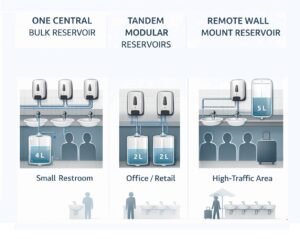
Refill Strategy
Refill design plays a major role in operational efficiency.
Many modern dispensers use sealed refill cartridges
that prevent contamination and reduce spills.
Other systems use bulk or multi-feed refill technology
that supplies multiple dispensers from a single reservoir,
reducing refill frequency in large facilities.
Operational problems to avoid include:
- messy refill procedures
- frequent refill cycles in high-traffic areas
- leaks or spills during maintenance
- limited refill compatibility
Brand Comparison Table
The following comparison provides a practical overview of leading
commercial soap dispenser brands. It highlights representative products,
technology features, and the types of facilities where each brand
typically performs best.
Brand |
Top Product Example |
Technology Highlights |
Best Use Cases |
|---|---|---|---|
FontanaShowers |
Fontana Auto Soap Dispenser with Multifeed | Multifeed Kit, ToF Sensor, Waterproof Design | Airports, Malls, Hotels, Hospitals |
Gojo / Purell |
Purell ES8 Touch-Free Soap Dispenser | Energy-on-the-refill, Smartlink Monitoring | Hospitals, Offices, Education |
Bobrick |
Bobrick B-828 SureFlo Automatic Soap Dispenser | Top-fill design, Consistent portion control | Corporate, Healthcare, Retail |
BathSelect |
BathSelect Commercial Foam Sensor Dispenser | Multiple finish options, Long battery life | Universities, Luxury Hotels |
ASI |
ASI Roval Automatic Soap Dispenser | ADA-compliant, Stainless Steel | Public Washrooms, Institutions |
Rubbermaid Commercial |
Rubbermaid AutoFoam Dispenser | Antimicrobial materials | Retail, Fast Food, Healthcare |
Bradley Corp |
Bradley Verge Soap + Faucet System | Integrated faucet system | Green Buildings |
TOTO |
TOTO EcoPower Soap Dispenser | Self-powered EcoSensor | Healthcare, Airports |
Sloan |
Sloan ESD-500 Soap Dispenser | Hardwired/Battery options | Government Buildings |
Kimberly-Clark |
Aquarius Touchless Dispenser | Sealed refills | Industrial Facilities |

Frequently Asked Questions
What is the best commercial soap dispenser type for high-traffic restrooms?
The most effective option for busy restrooms is typically a
touchless automatic soap dispenser that provides
consistent dosing and minimizes contact points.
High-capacity or sealed refill systems help prevent empty
dispensers during peak usage periods.
Do touchless dispensers reduce cross-contamination?
Yes. Touch-free activation eliminates shared pump handles,
helping reduce the spread of bacteria and improving overall
restroom hygiene.
How can facilities reduce maintenance costs?
Choose systems with reliable sensors, long battery life,
and refill systems that reduce service frequency.
Standardizing a dispenser model across a facility can
also simplify maintenance and inventory management.
What is the recommended installation height?
Most commercial dispensers are installed so the outlet
is approximately 40-48 inches above the finished floor.
Placement should allow comfortable hand positioning
while meeting accessibility requirements.
What installation mistakes should be avoided?
- placing sensors directly in front of mirrors
- installing units too far from the sink basin
- blocking the sensor detection area
- installing units without secure wall anchors
Related Articles
Multifeed Soap Dispenser Cutting-Edge Technology
How to Buy the Fontana Multifeed Kit?