
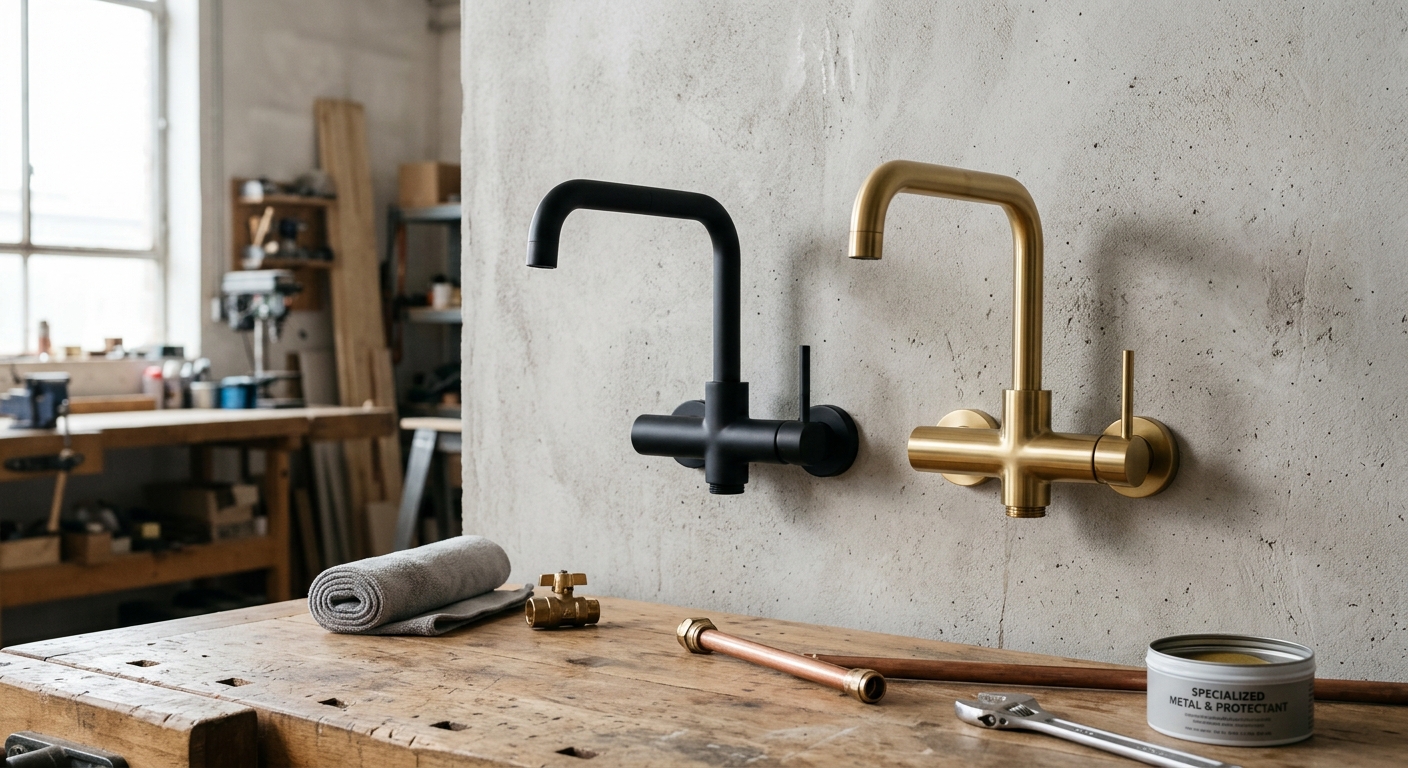
Your matte black faucet is turning shiny at the handles or spotting near the spout because the wrong cleaner or a worn cloth is breaking down the finish, and the fix depends on which of two finishes you actually have. Sprayed and powder-coated matte black is a paint-like layer that wears off with friction and strong chemicals. PVD (physical vapor deposition) is a vacuum-bonded metal layer that resists wear but still etches under acidic or alkaline cleaners. Match your cleaning method to the finish and you stop the problem instead of chasing it.
Identify Your Finish Type First
Before you clean anything, figure out what you’re dealing with. This matters because the two finishes fail in opposite ways and respond to different fixes.
- Sprayed or powder-coated matte black: Has a slight texture you can feel with a fingernail. Chips reveal a different color underneath (usually chrome or brass). Wears shiny at contact points first, like the lever and base.
- True PVD matte black: Feels smooth and uniform, almost like the metal itself was dyed. PVD is a vacuum-deposited metal nitride layer only a few microns thick, applied directly to the base metal in a sealed chamber. It doesn’t chip the way paint does. When it fails, it fails as dulling or micro-scratching, not flaking.
If you’re not sure, check the spec sheet or product listing that came with the fixture. Manufacturers list PVD by name because it costs more to apply and they want credit for it. If the listing just says “matte black” with no process named, assume it’s coated, not PVD, and treat it accordingly.
Daily Wipe-Down Tools and Technique
Daily maintenance is the same tool for both finishes, just different handling pressure.
- Use a microfiber cloth, not paper towel or a cotton rag. Paper towel has wood fibers that scratch at the microscopic level. Cotton rags often have a rougher weave that does the same thing over time.
- Dampen the cloth with distilled water, not tap water. Tap water leaves mineral spots as it evaporates, and those spots are what you’re probably seeing as “spotting” right now.
- Wipe in one direction along the length of the fixture, not in circles. Circular wiping grinds grit into the surface instead of lifting it off.
- Dry immediately with a second dry microfiber cloth. Air-drying is what causes hard water spotting in the first place.
This takes under a minute per fixture and is the single habit that prevents most of the shine and spotting complaints people have with matte black.
Weekly Clean Without Stripping Sheen
Once a week, or more often in hard water areas, do a slightly deeper clean.
- Coated finish: Mix a few drops of pH-neutral dish soap into distilled water. Wipe with a microfiber cloth, rinse with a second cloth dampened in plain distilled water, then dry. Do not scrub. The coating is thin enough that scrubbing is what causes the shiny wear spots at the handle.
- PVD finish: Same soap-and-water mix works, but PVD tolerates slightly more wiping pressure since it’s bonded to the metal rather than sitting on top of it. Still dry fully afterward. Water spots that sit for days can etch into PVD just like they can etch into stainless steel.
For both finishes, keep cleaner at a safe pH range of roughly 6 to 8. Most dish soaps and glass cleaners fall in this range, but check the label if you’re using anything marketed as “heavy duty” or “industrial,” since those often run higher alkaline for grease-cutting power.
Chemicals That Degrade Each Finish
This is where most matte black fixtures actually get damaged, usually by someone using a bathroom cleaner that works fine on tile and grout but is too harsh for a thin metal finish.
Never use chlorine bleach, ammonia, or abrasive pads on either finish. Bleach and ammonia both sit outside the safe pH window and will dull or discolor matte black within a few applications. Abrasive pads, including the green scrub pads and anything labeled “non-scratch” on glass cooktops, are still more abrasive than either finish can handle.
Beyond those three, watch for:
- Vinegar-based descalers left to sit. Short contact is sometimes fine on PVD, but soaking is not, and it’s never fine on coated finishes.
- CLR or other acidic lime removers. These are formulated for chrome and stainless, not matte finishes.
- Magic eraser style melamine sponges. They’re mildly abrasive by design and will create the exact shiny patches you’re trying to avoid.
- Alcohol-based disinfecting wipes used daily. Occasional use is usually fine, but daily alcohol exposure dries out and can haze a coated finish over months.
Touch-Up Options by Finish Type
If damage is already done, your options differ sharply between the two finishes.
Coated finish: Small chips can sometimes be touched up with a matte black appliance or metal touch-up paint matched as closely as possible to the original sheen. This is a cosmetic patch, not a repair, and it won’t blend perfectly under close inspection. For wear that’s spread across the handle or spout, the only real fix is replacement or professional refinishing, which usually costs more than buying a new fixture of the same tier.
If you’re shopping for a replacement fixture rather than patching the one you have, it’s worth knowing that fixture lines vary in which finish process they actually use even when both are marketed as “matte black.” Juno’s matte black kitchen taps are one example where the product listing specifies the finish process, which makes it easier to match care instructions to what you’re actually buying instead of guessing.
PVD finish: There is no real touch-up option. Because the color is the metal layer itself, not a coating on top, a scratch exposes base metal and can’t be painted over without looking obviously wrong. The upside is that PVD rarely needs touch-up in the first place since it resists the wear that causes most coated-finish damage. If PVD is scratched through to base metal, replacement is the only fix.
Quick-Reference Compatibility Chart
| Task | Coated Matte Black | PVD Matte Black |
|---|---|---|
| Daily wipe tool | Microfiber + distilled water | Microfiber + distilled water |
| Weekly cleaner | pH-neutral soap, no scrubbing | pH-neutral soap, light scrubbing OK |
| Bleach / ammonia | Never | Never |
| Abrasive pads | Never | Never |
| Vinegar descaler | Avoid | Short contact only, rinse fast |
| Chip or scratch repair | Touch-up paint, cosmetic only | Not repairable, replace if exposed |
Before you finish the job, wipe down every fixture you installed or cleaned today with dry microfiber one more time. If you still see spotting after a distilled-water wipe, the water itself is the problem, not your technique, and a simple inline filter on the supply line will solve it. If a coated fixture is already showing bare metal at the wear points, stop trying to clean it back to new and start pricing replacement, since no cleaner reverses coating loss. When in doubt about which finish you have, contact the manufacturer with the model number before you apply anything stronger than soap and water.